
Dropshipping is one of the most accessible business models ever created — no warehouse, no upfront inventory, no packing tape on your kitchen floor. But “accessible” doesn’t mean “automatic.” In 2026, with global ecommerce revenue projected to surpass $6.8 trillion, the opportunity is real — and so is the competition.
This guide is your complete roadmap. Whether you’re starting from zero or moving from another platform, you’ll learn exactly how to build a profitable Shopify dropshipping store, from picking a niche to scaling your first winning product.
What Is Shopify Dropshipping — And How Does It Work?
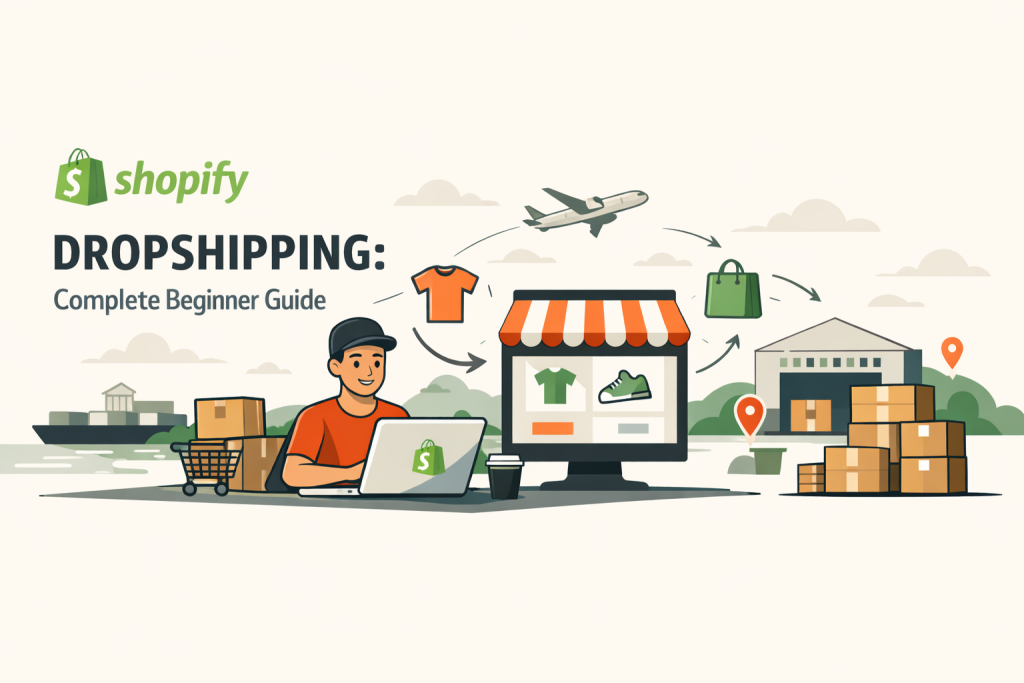
Shopify dropshipping is a retail fulfillment method where you sell products through your Shopify store without holding any inventory. When a customer places an order, you purchase the item from a third-party supplier (usually overseas), who ships it directly to the customer.
The basic flow looks like this:
- A customer visits your Shopify store and buys a product for $49.99
- You receive the order and forward it to your supplier (manually or via automation)
- Your supplier charges you the wholesale price — say, $12
- Your supplier ships the product directly to your customer
- You pocket the $37.99 margin
It sounds simple — and the mechanics are. The skill lies in choosing the right products, building a trustworthy brand, and driving targeted traffic that converts.
Why Shopify specifically? As of 2025, Shopify powers over 4.8 million active stores across 175 countries. It offers purpose-built dropshipping integrations, a massive app ecosystem, and a checkout that converts — conversion rates on Shopify average 1.4% versus the industry average of around 1.0–1.2%.
Is Shopify Dropshipping Still Worth It in 2026?
Yes — but the game has changed. Here’s an honest breakdown.
The case FOR dropshipping in 2026:
- Low startup costs (you can launch for under $100)
- No warehouse or inventory risk
- Location-independent — run your store from anywhere
- Global supplier networks make product sourcing easier than ever
- AI-powered tools now dramatically reduce time spent on product research and ad creative
The honest challenges:
- Shipping times from overseas suppliers (typically 7–21 days) are a growing customer pain point
- Competition for popular products is fierce — margins get squeezed fast
- Customer service issues (lost packages, sizing discrepancies) fall on you, even though fulfillment doesn’t
- Ad costs on Meta and TikTok have increased; paid traffic requires smarter targeting than in prior years
The bottom line: Dropshipping remains a legitimate, profitable model in 2026 — but success goes to entrepreneurs who treat it as a real business, not a passive income hack.
Step 1: Choose a Profitable Niche
Your niche is the foundation of everything. A bad niche choice compounds every mistake afterward; a good one makes every decision easier.
What makes a niche profitable for dropshipping?
- Passionate audience — Hobbyists, pet owners, fitness enthusiasts, and parents tend to spend freely and search actively
- Non-commodity products — Avoid categories like generic phone cases or plain t-shirts where Amazon dominates and margins are razor-thin
- Problem-solving products — Products that solve a specific, felt pain point convert better than “nice to have” items
- Visual appeal — TikTok and Instagram are still primary traffic sources; products that demonstrate well in video outperform static items
High-potential niche categories in 2026:
- Pet accessories and enrichment products
- Home organization and space-saving solutions
- Eco-friendly and sustainable lifestyle products
- Fitness recovery tools (massage guns, mobility aids)
- Outdoor recreation and adventure gear
- Desk and home office accessories
- Baby and toddler gear
- Niche hobby supplies (plant care, journaling, model-building)
Tools for niche research:
- Google Trends — Free; shows search volume trajectory over time
- Minea — Tracks trending products across Facebook, TikTok, and Pinterest ads
- Exploding Topics — Surfaces emerging trends before they peak
- Reddit / Facebook Groups — Qualitative research; find what problems real people complain about
Step 2: Find Reliable Suppliers
Your supplier is your operational backbone. A bad supplier means late deliveries, quality complaints, and refund requests — all of which destroy your Shopify store’s reputation and your ad spend ROI.
Top supplier platforms for Shopify dropshippers:
AliExpress + DSers
The most beginner-friendly combination. DSers is Shopify’s official AliExpress dropshipping tool, replacing the now-deprecated Oberlo. It allows bulk order processing, supplier comparison, and automated tracking updates.
- Best for: Beginners testing products with low upfront risk
- Typical shipping time: 10–20 days (AliExpress Standard Shipping); faster with DHL/UPS at higher cost
Spocket
A curated marketplace of US and EU-based suppliers. Faster shipping (3–7 days), higher-quality products, and branded invoicing options.
- Best for: Brands targeting North American or European customers who demand fast delivery
- Pricing: Starts at $39.99/month
Zendrop
Strong in the beauty, health, and lifestyle categories. Offers a US fulfillment center option (2–5 day shipping), product bundling, and private labeling for scaling sellers.
- Best for: Intermediate dropshippers ready to build a branded product line
CJ Dropshipping
Hybrid model — sourcing + fulfillment warehouse. Useful for custom packaging and product customization without MOQ (minimum order quantity) requirements.
- Best for: Sellers wanting private label without bulk ordering
AutoDS
Automation-first platform covering product research, supplier connections, automatic price and stock monitoring, and order fulfillment.
- Best for: High-volume stores where manual management becomes impractical
Green flags when evaluating any supplier:
- Response time under 24 hours
- Verifiable reviews and order history
- Clear return/refund policy
- Ability to send product samples before you sell
Step 3: Set Up Your Shopify Store
With your niche and supplier locked in, it’s time to build. A well-structured store takes 1–3 days to set up properly.
Your Shopify setup checklist:
- [ ] Choose a plan (Basic at $39/month is sufficient for most beginners)
- [ ] Select and customize a theme (Dawn is Shopify’s free, fast-loading default; Debutify and Booster are popular paid alternatives)
- [ ] Connect your custom domain (~$14/year via Shopify or GoDaddy)
- [ ] Install your dropshipping supplier app (DSers, Spocket, etc.)
- [ ] Import 10–30 products and write custom product descriptions — never use supplier copy-paste descriptions
- [ ] Set up payment processing (Shopify Payments, PayPal, or both)
- [ ] Configure shipping zones and rates
- [ ] Install Google Analytics 4 and Meta Pixel before running any ads
- [ ] Create essential legal pages: Privacy Policy, Terms of Service, Refund Policy, Shipping Information
- [ ] Set up a professional business email (not @gmail.com)
Must-have Shopify apps for dropshippers:
| App | Purpose | Cost |
|---|---|---|
| DSers or Spocket | Supplier integration | Free / Paid |
| Loox or Judge.me | Product reviews with photos | From $9/mo |
| Klaviyo | Email & SMS marketing automation | Free up to 250 contacts |
| Tidio | Live chat and AI chatbot | Free / Paid |
| ReConvert | Post-purchase upsell flows | From $4.99/mo |
| Triple Whale | Multi-channel analytics | From $129/mo |
Step 4: Price Your Products for Profit
Pricing is where most beginners leave money on the table — or price themselves out of profit entirely.
A simple pricing formula:
Selling Price = (Product Cost + Shipping Cost) × 3 to 5×
Example: If you source a product for $8 and shipping costs $4, your total landed cost is $12. At a 3× markup, your retail price is $36. At 4×, it’s $48.
Why the 3–5× multiplier? Because you need to cover:
- Shopify subscription and app fees
- Payment processing fees (~2.9% + $0.30 per transaction)
- Advertising costs (you should target a ROAS of at least 2.5–3× on paid traffic)
- Customer service overhead
- Refunds and chargebacks (budget 2–5% of revenue)
Price anchoring tip: Always display a “Compare At” price in Shopify to show the original value. Psychologically, a product at “$39.99 (was $79.99)” converts significantly better than a flat “$39.99” — as long as the comparison is credible.
Step 5: Drive Traffic to Your Store
A beautiful store with zero visitors makes zero sales. Traffic is the lifeblood of any dropshipping business.
Paid Traffic
TikTok Ads are the dominant channel for dropshippers in 2026, particularly for visually demonstrable products targeting buyers under 40. TikTok’s CPMs (cost per thousand impressions) are still lower than Meta’s in most categories, and the algorithm rewards creative quality over pure spend.
Meta Ads (Facebook + Instagram) remain essential, especially for retargeting. Broad targeting with strong creative — rather than hyper-specific interest stacking — is the Meta strategy that most high-performing dropship brands now use.
Google Shopping Ads are highly effective for products with established demand (people are already searching). Lower competition than paid social for many niches.
Organic Traffic
- TikTok organic — Posting genuine unboxing, demo, and review-style videos can go viral and drive thousands of visitors with zero ad spend. Many six-figure dropship brands started entirely on organic TikTok
- SEO and blogging — Slower to build but produces compounding, free traffic. Target long-tail keywords like “best [product] for [use case]”
- Pinterest — Underrated for home, fashion, beauty, and hobby niches. Pins have a much longer shelf life than social posts
- Influencer partnerships — Micro-influencers (10,000–100,000 followers) often accept product gifting in exchange for posts; effective for brand building with low cash outlay
Step 6: Optimize Conversion Rate
Getting traffic is only half the battle. Your store needs to convert visitors into buyers.
High-impact CRO (conversion rate optimization) tactics:
- Urgency and scarcity — “Only 7 left in stock” or countdown timers on offers (use sparingly and honestly)
- Social proof — Photo reviews, star ratings visible on product thumbnails, and “X people are viewing this” notifications all increase trust
- Trust badges — SSL certificates, payment icons, money-back guarantee badges near the Add to Cart button
- Fast page speed — Every 100ms of load time delay reduces conversions by ~1%. Compress images, limit app bloat, and use a lightweight theme
- Mobile-first design — Over 70% of Shopify traffic now comes from mobile devices. Test every page on mobile before launching
- Clear shipping expectations — Be upfront about delivery timelines. Hiding long shipping times leads to chargebacks; being transparent about them reduces them
- Strong product descriptions — Focus on benefits over features. Answer the question: “What will my life look like after I own this?”
Step 7: Handle Customer Service Professionally
Customer service is the hidden differentiator in dropshipping. Most stores do it poorly — which means doing it well is a genuine competitive advantage.
Set up these systems before your first sale:
- A dedicated support email (support@yourbrand.com)
- An auto-responder that sets expectations on response time
- A templated FAQ covering shipping times, returns, and tracking
- A clear, fair refund policy (30-day no-questions-asked is now the customer expectation)
- Proactive shipping notifications via Klaviyo or Aftership
For stores doing over 50 orders per day, a part-time virtual assistant handling tier-1 support inquiries is worth every penny.
Step 8: Scale What Works
Once you have a product generating consistent, profitable sales — usually defined as 20+ orders per day with a ROAS above 2.5× — it’s time to scale.
Scaling levers:
- Increase ad budget 20–30% every 3–4 days (aggressive scaling often kills performance)
- Duplicate winning ad sets to new audiences
- Expand to new traffic channels (if TikTok is working, test Meta; if Meta is working, test Google)
- Add product variants, bundles, or complementary products to increase AOV (average order value)
- Build an email and SMS list — owned audiences are your most profitable long-term asset
- Consider private labeling your winning product to reduce competition and increase margins
Key metrics to track daily:
- ROAS (Return on Ad Spend)
- CAC (Customer Acquisition Cost)
- AOV (Average Order Value)
- Refund rate
- LTV (Lifetime Value) — even dropshippers with repeat-purchase products can build strong LTV
Real-World Example: From $0 to $50K/Month
Consider this trajectory, based on common patterns among successful Shopify dropshippers:
Month 1: Niche selected (pet accessories), Shopify store built, 3 products imported and optimized. $500 test budget spent on TikTok ads. One product — a self-cleaning slicker brush — generates 47 orders at a $24 AOV. ROAS: 2.1× (barely profitable, but a proven winner).
Month 2: Creative refreshed, ad budget scaled to $3,000/month. Email list built with a 10% discount pop-up (2,200 subscribers). New complementary product added (deshedding glove). Revenue: $18,000. Net profit after all costs: ~22%.
Month 3: Meta Ads launched to retarget site visitors. Klaviyo welcome flow and abandoned cart sequence activated. Influencer gifting sent to 12 pet micro-influencers. Revenue: $51,000. Profit margin maintained at ~20%.
This is not an outlier — it’s a repeatable pattern for entrepreneurs who commit to testing, learning, and optimizing rather than chasing the next “winning product.”
Tools Every Shopify Dropshipper Needs in 2026
| Category | Tool | What It Does |
|---|---|---|
| Product Research | Minea | Spy on winning ads across platforms |
| Product Research | AutoDS Product Finder | Data-driven trending product discovery |
| Supplier | DSers | AliExpress order automation |
| Supplier | Spocket | US/EU fast-shipping suppliers |
| Store Building | Shopify (Dawn theme) | Core platform |
| Email Marketing | Klaviyo | Flows, campaigns, segmentation |
| Analytics | Triple Whale | Unified ad + store analytics |
| Reviews | Loox | Photo review collection |
| Ad Creative | AdCreative.ai | AI-generated ad variations |
| Customer Service | Tidio | Live chat + AI chatbot |
How Much Does It Cost to Start Shopify Dropshipping?
Here’s a realistic startup budget breakdown:
- Shopify Basic plan: $39/month
- Domain name: ~$14/year (≈$1.17/month)
- Essential apps (reviews, email, chat): ~$30–60/month
- Test ad budget (recommended minimum): $500–$1,000/month
- Product samples (optional but recommended): $50–$150
Realistic minimum to launch and test properly: $600–$1,200
You can start for less — some beginners start with $200–$300 — but insufficient ad budget means insufficient data, which means you can’t make informed decisions about what to scale.
FAQ: Shopify Dropshipping for Beginners
Q: Do I need a business license to start dropshipping on Shopify? Requirements vary by country and state. In the US, most dropshippers operate as a sole proprietor initially (no formal registration required), then form an LLC once they’re generating consistent revenue. Consult a local accountant or legal advisor for guidance specific to your location.
Q: How long does it take to make money dropshipping? Most beginners who follow a structured approach see their first profitable sales within 30–60 days. A consistent $5,000+/month revenue run rate typically takes 3–6 months. Results vary significantly based on niche selection, ad budget, and how quickly you test and iterate.
Q: Is dropshipping from AliExpress still viable in 2026? Yes, but with caveats. Long shipping times remain a challenge. The most successful current approach is to use AliExpress/DSers for product validation, then switch to a faster supplier (Spocket, Zendrop, CJ Dropshipping) once you have a proven winner.
Q: What’s the profit margin for dropshipping? Typical net margins range from 15–30% after accounting for product cost, shipping, ads, and Shopify fees. Margins below 15% are difficult to scale sustainably. Private labeling and email marketing (high-margin owned channel) are the primary levers to increase profitability.
Q: Can I dropship with Shopify without paid ads? Yes — organic TikTok, SEO, and Pinterest can drive meaningful traffic without ad spend. However, purely organic growth is slower and less predictable. Most successful dropshippers use a hybrid approach: organic content to validate products and build brand awareness, paid ads to accelerate and scale.
Q: How many products should I start with? Start with 10–20 curated, well-described products rather than importing hundreds. Depth of optimization beats breadth every time. Focus on 1–3 “hero products” for your initial ad testing.
Q: What happens if a customer wants a refund? You refund the customer from your margins — most suppliers do not offer free returns. This is why maintaining a 3–5× markup matters. Budget 2–5% of revenue for refunds and build a generous return policy to maximize customer trust and reduce chargebacks.
Q: Is Shopify dropshipping saturated? The generic, low-effort model is saturated. A well-branded store in a specific niche, with strong creative, solid customer service, and a real marketing strategy is not saturated — it’s a real business, and real businesses succeed in competitive markets every day.
Final Thoughts: Your 2026 Dropshipping Roadmap
Shopify dropshipping in 2026 rewards entrepreneurs who approach it with intention. The barriers to entry are low, but the barriers to success are where most people stumble — and they’re all about execution, not secrets.
Your action plan:
- Spend 1 week on niche and product research before touching Shopify
- Build your store over 3–5 days — don’t spend months perfecting a store before testing
- Allocate a real test budget ($500–$1,000) and commit to learning from the data
- Treat customer service as a brand investment, not a cost center
- Scale what works; cut what doesn’t; document everything
The ecommerce market is enormous, and it’s still growing. Your slice of it starts with the next decision you make.
Editorial Team, Dropshipping.Media