
Every few years, a new wave of entrepreneurs discovers dropshipping and declares it either a goldmine or a scam, depending largely on what happened to them personally. The reality sits somewhere more complicated — and more interesting — than either camp admits.
The global dropshipping market was valued at approximately $243 billion in 2023, according to Grand View Research, and projections suggest it will grow at a compound annual rate of over 23% through 2030. Those numbers have attracted millions of first-time sellers to Shopify, WooCommerce, and Amazon. Most of them launch. A smaller fraction build something durable.
What separates the two groups rarely comes down to the products they sell. It comes down to how well they understand the model before they start. Dropshipping has a specific logic — supplier relationships, margin mechanics, fulfillment dependencies — and founders who grasp that logic early make dramatically better decisions. Those who treat it as a passive income shortcut tend to hit a wall around month three.
This guide is written for founders who want the full picture.
What Is Dropshipping, Exactly?
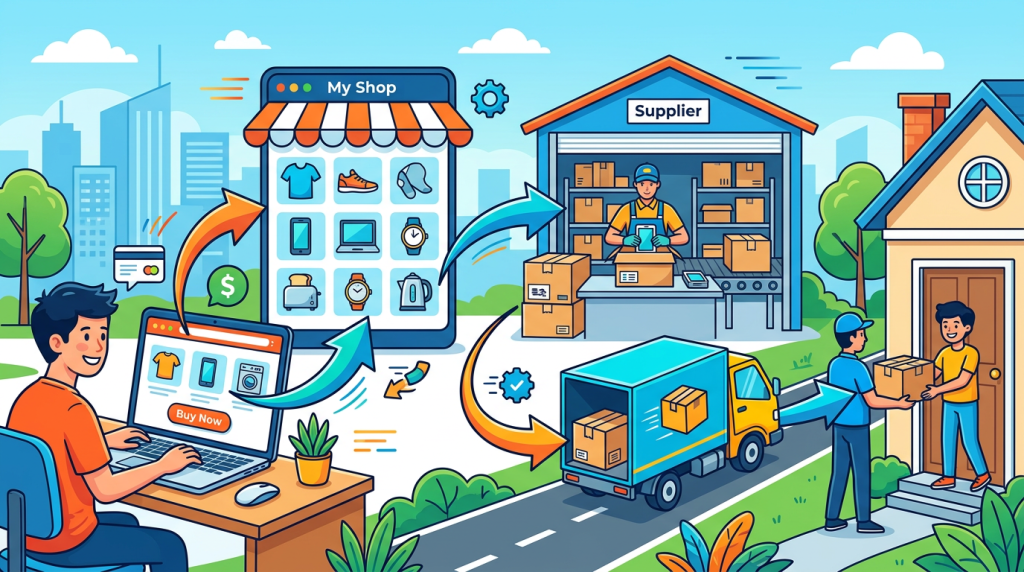
At its most basic, dropshipping is a retail fulfillment method where a store sells products it does not physically stock. When a customer places an order, the seller forwards it to a third-party supplier — a manufacturer, wholesaler, or distributor — who ships the item directly to the customer. The seller never handles the inventory.
The financial mechanics are straightforward. A seller lists a product for $49. Their supplier charges $18 for that product, including fulfillment. The seller keeps the $31 difference, minus platform fees, payment processing, and any advertising spend. Margins vary widely depending on the niche, but gross margins in the 20–40% range are common across mid-tier dropshipping operations.
What makes the model genuinely compelling for new entrepreneurs is the capital structure. Traditional retail requires buying inventory before you know whether customers want it. Dropshipping inverts that risk. You pay your supplier only after a customer has already paid you. For someone testing a new product category or entering ecommerce for the first time, that difference is significant.
How Dropshipping Actually Works: Step by Step
The operational flow of a dropshipping business involves five recurring stages. Understanding each one is essential because problems almost always originate in the gap between stages — in the handoff points that sellers don’t think through in advance.
Step 1: You set up a storefront. Most dropshippers start on Shopify, which holds roughly 28% of the US ecommerce platform market. Others use WooCommerce, BigCommerce, or Wix. A minority list on Amazon through its third-party seller marketplace.
Step 2: You source and list products. You identify a supplier, typically through a platform like AliExpress, CJ Dropshipping, Alidrop, Spocket, or a private wholesale relationship. You import the product data — images, descriptions, pricing — and publish it to your store, usually with a marked-up price.
Step 3: A customer places an order. The transaction is processed through your payment gateway. The money lands in your account, minus platform and processing fees.
Step 4: You forward the order to your supplier. This can be manual, but most sellers automate it using tools like DSers, AutoDS, or Zendrop, which connect your store directly to supplier systems and handle order routing in real time.
Step 5: The supplier ships directly to your customer. Depending on your supplier’s location and the shipping method chosen, delivery might take three days or three weeks. That variance is one of the most consequential operational decisions a dropshipper makes.
After that cycle, customer service, returns, and reviews fall back to you — even though you never touched the package.
The Core Advantage: Why Entrepreneurs Choose This Model
The appeal of dropshipping goes beyond the low entry cost, though that matters. Starting a traditional product business often requires $10,000 to $50,000 in initial inventory, plus warehousing. A dropshipping store can be operational for under $500, including the domain, platform subscription, and early advertising tests.
But the more strategic advantage is speed. A conventional brand might spend six months developing a product, manufacturing it, and importing it before ever showing it to a customer. A dropshipper can test ten products in that same time frame, find out which one actually converts, and then decide whether to invest more deeply in that category — potentially moving to private labeling or bulk purchasing once demand is proven.
Shopify merchants who use dropshipping to test product-market fit before committing to inventory have reported dramatically lower initial CAC (customer acquisition cost) relative to those who launch with a single bet on one SKU. The logic is probabilistic: more tests, better odds of finding something that works.
Scalability is another genuine strength. Because you’re not constrained by warehouse capacity or inventory reorder timing, a dropshipping store can theoretically handle a 10x spike in orders without operational bottleneck — assuming your supplier can keep up.
The Real Drawbacks (That Most Guides Underplay)
Here is where many introductory articles on dropshipping become unhelpful. They mention the disadvantages briefly, then pivot back to enthusiasm. The risks deserve more honest treatment.
Thin and fragile margins. Many beginners underestimate total cost of goods. The supplier’s listed price is just the start. Add 2–3% for payment processing, Shopify’s transaction fee (if not on Payments), return costs, and the biggest variable: paid advertising. Running Facebook or TikTok ads to acquire customers in a competitive niche can easily push total acquisition costs above gross profit margins. Sellers who don’t model this before launching frequently discover they’ve been running a business that loses money at scale.
Zero supply chain control. When a supplier runs out of stock, ships damaged goods, or quietly extends their processing time from two days to ten, the seller absorbs the consequences. Customer reviews, chargeback rates, and account health on marketplaces all reflect the supplier’s performance, not just yours. This is the operational tension at the heart of every dropshipping business: the seller is accountable for outcomes they don’t control.
Intense competition on commodity products. If a product is available on AliExpress and you can list it, so can ten thousand other sellers. Many of them will undercut your price. Building a defensible position in dropshipping almost always requires differentiation — through branding, curation, content, or customer experience — rather than competing on identical products at similar price points.
Customer service complexity. Returns and disputes in dropshipping are genuinely messy. The customer doesn’t know or care that a third party shipped their order. They want their refund from you. Coordinating returns with overseas suppliers, absorbing refund costs on disputed shipments, and managing chargeback ratios requires systems and policies that many beginners haven’t built before they need them.
Dropshipping Business Models: Not All the Same
The term “dropshipping” covers a range of operational approaches that differ meaningfully in risk profile, margin potential, and complexity.
General store model. A broad-inventory store testing many product categories simultaneously, usually built around impulse buys or trending items. Advantages include speed of testing. Disadvantages include brand dilution, higher return rates, and difficulty building a loyal customer base.
Niche store model. A store focused on a specific audience or category — outdoor gear, pet accessories, home office products. Easier to build SEO authority, email lists, and repeat purchase rates. Harder to pivot if the niche underperforms.
One-product store model. A single landing-page-style store built around one winning product, with all creative and advertising optimized for that item. Conversion rates are typically higher because there are no navigation distractions. The risk is complete dependency on one product’s continued demand.
Private label dropshipping. A more advanced model where the seller sources a product through a dropship supplier but sells it under their own brand, with custom packaging. Slower to launch, but significantly higher margins and brand equity over time. This is where many successful dropshippers eventually migrate.
Finding Suppliers: The Decision That Shapes Everything
Supplier selection is probably the highest-leverage operational decision in early-stage dropshipping. Most first-time sellers default to AliExpress because it’s accessible. That’s not wrong as a starting point, but it’s worth understanding the landscape more fully.
AliExpress remains the most accessible option for beginners — a massive marketplace of Chinese suppliers with low minimum orders and integration with platforms like DSers. Shipping times have improved with ePacket and newer logistics networks, but delivery to US or European customers still averages 10–20 days for standard options, which creates customer experience risk.
CJ Dropshipping operates a hybrid model: warehouses in multiple countries allow faster shipping, and they offer product customization and branding services. Slightly more complex to set up, but materially better on fulfillment speed.
Spocket focuses specifically on suppliers based in the US and EU, with the express purpose of offering 2–7 day delivery. Margins are thinner because supplier pricing is higher, but customer satisfaction data on stores using Spocket-sourced products tends to be stronger.
Zendrop has gained traction for its Shopify-native integration and automated fulfillment features. Particularly popular in the health, beauty, and lifestyle niches.
SaleHoo operates as a supplier directory with verified manufacturers and wholesalers — useful for sellers who want to evaluate multiple suppliers before committing to a relationship.
One pattern worth noting: the sellers who build durable businesses tend to move eventually toward direct supplier relationships, negotiating custom agreements outside of marketplace platforms. That’s harder at the beginning, but it’s worth knowing it’s the direction of travel.
Product Research: Where Winning Stores Start
The product research phase is where most dropshipping businesses are won or lost before they ever launch. The goal is to find items with demonstrated demand, manageable competition, and workable economics — a combination that is less common than product research tools might suggest.
Several platforms have become standard in the toolkit of serious product researchers:
- Minea — Tracks ads across Facebook, TikTok, and Pinterest to surface trending products and winning creatives. Particularly useful for identifying products with active ad spend, which is a proxy for market validation.
- Sell The Trend — An all-in-one platform with trend tracking, competitor analysis, and supplier finding, popular among Shopify dropshippers.
- Exploding Topics — Useful for identifying categories before they become saturated, tracking search trend momentum across verticals.
- Google Trends — Underutilized by beginners. Seasonal analysis and geographic demand data are essential for avoiding products with declining trajectories.
- Helium 10 / Jungle Scout — Primarily Amazon tools, but the product demand and competition data they surface is useful for any ecommerce seller evaluating category viability.
A practical research framework: look for products with a clear problem-solving angle (not novelty alone), a retail price point that allows a 3–4x markup over supplier cost, and evidence of active advertising by multiple sellers — which suggests the market is working, even if competition exists.
One common mistake: selecting products based on how interesting they seem rather than what the data shows about buyer intent. Several Shopify sellers running stores in the home décor and pet niche have noted that their worst-performing launches were products they personally loved but that showed weak search volume and no ad activity from competitors.
Building Your Store: The Conversion Layer
A dropshipping store’s profitability is partly a function of supplier economics and partly a function of how well the store itself converts traffic into buyers. Experienced sellers understand that these two levers are equally important.
Conversion rate optimization (CRO) is the discipline of improving the percentage of visitors who complete a purchase. Industry benchmarks from Littledata suggest the average Shopify store converts at around 1.4%. Top-performing stores in competitive niches often reach 3–5%. The delta between those numbers, at any significant traffic volume, translates to substantial revenue differences.
Several elements drive conversion in dropshipping stores specifically:
Product page quality. The product page is doing the work that a physical store’s sales associate would do — building trust, answering objections, and making the product feel real and desirable. Generic manufacturer images and copied supplier descriptions fail at this. Stores that invest in original photography, benefit-led copy, and detailed specifications consistently outperform those that import content wholesale.
Social proof architecture. Reviews, ratings, and user-generated content reduce purchase anxiety. Tools like Loox, Judge.me, and Yotpo enable structured review collection and display. The psychology here is well-documented: a product with 200 reviews at 4.3 stars typically outconverts an identical product with 12 reviews at 4.8 stars, because volume signals authenticity.
Page speed. Google’s data consistently shows that each second of additional load time reduces conversions meaningfully. Shopify’s built-in optimization is solid, but theme selection and app bloat matter. A store loading in 4 seconds can expect to lose a meaningful share of the traffic it paid to acquire.
Trust signals. Payment security badges, clear return policies, and accessible customer service contact information all reduce checkout abandonment. Particularly for first-time visitors from paid ads — who have no prior relationship with the brand — these elements carry real weight.
Checkout friction. Shopify’s native checkout is strong, but sellers who use Shop Pay and enable accelerated checkout options typically see measurable improvement in checkout completion rates.
Tools of the Trade: What Serious Dropshippers Actually Use
Beyond product research, a functional dropshipping operation typically relies on a core stack of tools. The list has grown and shifted as AI-powered options have entered the market.
Store management:
- Shopify (dominant) or WooCommerce for the storefront
- DSers or AutoDS for order automation and supplier management
- Klaviyo or Omnisend for email marketing and abandoned cart recovery
Product content:
- Canva or Adobe Express for creative assets
- Copy.ai, Jasper, or Claude for product description drafting — though experienced sellers treat AI output as a first draft requiring significant editing, not a finished product
- Loom for recording customer-facing video content
Analytics and CRO:
- Google Analytics 4 for traffic and attribution analysis
- Hotjar or Microsoft Clarity for session recording and heatmap analysis
- Triple Whale for Shopify-specific attribution and ROAS tracking
Customer service:
- Gorgias — the dominant help desk platform for Shopify stores, with native order lookup and automation features
- Tidio for live chat with AI-assisted response drafting
Advertising:
- Meta Ads Manager (Facebook/Instagram) remains the highest-volume channel for most dropshippers
- TikTok Ads has grown rapidly and is particularly effective for visually demonstrative products
- Google Shopping for intent-based buyers already searching for the product category
Dropshipping on Amazon vs. Shopify: Key Differences
The platform choice shapes the entire business model, and the differences are more significant than platform comparison articles typically convey.
Amazon dropshipping operates under strict policy constraints. Amazon permits dropshipping in principle but prohibits purchasing from other retailers and shipping to Amazon customers — so AliExpress-to-Amazon models are explicitly against policy. Legitimate Amazon dropshipping involves wholesale relationships where the seller is the seller of record. Violating these policies results in account suspension, which can be catastrophic for a business built on that channel.
The advantage of Amazon is built-in buyer intent. Shoppers on Amazon are further down the purchase funnel. Conversion rates on Amazon listings typically run 10–15%, compared to 1–4% on independent Shopify stores. The tradeoff is margin compression from Amazon fees (typically 15% referral fee plus FBA costs if applicable) and the platform dependency risk of building a business on someone else’s infrastructure.
Shopify dropshipping offers greater margin potential and brand control, but requires the seller to generate their own traffic — which means paid advertising spend, SEO work, or social media content creation. That demand generation effort is where many new sellers underestimate time and cost requirements.
Many experienced sellers run both: using Amazon for discovery and demand validation, and Shopify for brand building, higher margins, and customer relationship development.
Legal and Tax Considerations
This section is not legal advice, but it addresses questions that new dropshippers frequently get wrong.
Business structure. Operating as a sole proprietor is the path of least resistance, but LLC formation — available in most US states for under $500 — provides liability protection and more credible vendor relationships. Most serious dropshippers register an LLC before reaching significant revenue.
Sales tax. In the US, following the Supreme Court’s 2018 decision in South Dakota v. Wayfair, online sellers may have sales tax nexus obligations in states where they exceed certain sales thresholds, even without physical presence. The specifics vary by state. Tools like TaxJar and Avalara automate sales tax calculation and filing — for any store generating meaningful revenue, these tools pay for themselves in compliance risk reduction.
Import duties and customs. When dropshipping from international suppliers, the customer is technically the importer of record in many jurisdictions. Packages valued over certain thresholds may be subject to customs duties. Sellers who don’t disclose this clearly in advance will face disputes.
Intellectual property. Dropshipping supplier marketplaces contain a significant volume of products that infringe on existing trademarks or patents. Selling them creates legal exposure. Product due diligence should include at minimum a basic trademark search before listing.
Realistic Expectations: What the Numbers Actually Look Like
It is worth being direct about the financial trajectory most dropshipping businesses follow, because the gap between expectation and reality is where most early exits happen.
A typical timeline for a new dropshipper on Shopify, based on patterns reported by sellers across communities like the Shopify community forums and dropshipping subreddits:
- Months 1–2: Store setup, product testing, initial ad spend. Most sellers are unprofitable. This is normal and expected.
- Months 3–4: If product-market fit is found, a seller may reach break-even or modest profit. Many don’t find it in this window and quit.
- Months 5–12: Sellers who persist and iterate typically start to see meaningful revenue, though net margins after ad spend are often in the 10–20% range.
- Year 2+: Stores that reach this stage have usually niched down, developed some brand identity, and begun building repeat purchase economics. This is where the business becomes defensible.
According to data aggregated by Oberlo (before Shopify discontinued it), approximately 10–20% of dropshipping stores achieve sustained profitability. That is not a reason to avoid the model — the majority of new businesses in any category fail — but it is a reason to approach it with realistic expectations and a testing mentality rather than a get-rich framing.
Frequently Asked Questions
Is dropshipping still profitable in 2024 and 2025?
Yes, but the conditions have shifted. Advertising costs on Meta have increased substantially since 2021, which compressed margins for sellers relying heavily on paid acquisition. Profitability now requires stronger creative strategy, better conversion optimization, and tighter supplier economics than it did in the early Shopify era. Sellers who treat it as a push-button income model typically struggle. Those who approach it as a real business — with customer experience, brand positioning, and economics genuinely understood — can still build very profitable operations.
How much money do I need to start dropshipping?
The technical minimum is extremely low — Shopify starts at $39/month and supplier costs are zero until a sale is made. But a realistic startup budget for someone serious about testing their concept is $1,000–$3,000, which covers platform fees, basic design work, and enough advertising spend to generate meaningful test data. Starting with less is possible; it just extends the timeline to meaningful results.
Do I need a business license to dropship?
Requirements vary by country and region. In the US, most states require a business license if you’re operating commercially. An LLC or sole proprietorship registration is typically the right starting point. Consult a local business attorney or accountant for specific guidance.
What are the best niches for dropshipping?
The most durable dropshipping niches tend to share certain characteristics: clear buyer intent, passionate communities, products that solve a specific problem, and categories where visual content performs well. Home and garden, pet products, outdoor and sports equipment, and health and wellness have shown consistent demand. High-ticket niches (products priced above $200) are worth considering despite complexity — margins per unit are substantially higher, which improves advertising economics.
How do I handle returns in dropshipping?
Return policies vary by supplier. Many AliExpress-based suppliers do not accept returns, which means the seller absorbs refund costs directly. Building an explicit return policy that customers see before purchase, and provisioning a percentage of revenue for returns in your margin model, is essential. Sellers in higher-volume operations often absorb returns rather than routing them internationally, because the logistics cost of returning a $25 item to China can exceed the item’s value.
Can I build a real brand through dropshipping?
Increasingly, yes — and the sellers who do this are the ones building the most durable businesses. This involves custom packaging through print-on-demand services, branded inserts, domain-matched email communication, and content marketing that speaks directly to a specific audience. The product might come from a supplier, but the customer relationship and brand perception are entirely in the seller’s control.
Is dropshipping allowed on Amazon?
Amazon permits dropshipping under specific conditions: the seller must be the seller of record on all invoices and packaging, and purchasing items from other retailers to ship to Amazon customers is prohibited. The policy is stricter than many assume, and violations can result in account suspension.
What is the difference between dropshipping and print-on-demand?
Print-on-demand (POD) is a subset of dropshipping where products — typically apparel, home goods, or accessories — are printed with custom designs only after a sale is made. Platforms like Printful, Printify, and Gelato handle production and fulfillment. The model eliminates inventory risk entirely and allows sellers to build design-led brands. Margins are thinner than traditional dropshipping in many cases, but creative differentiation is much easier.
Dropshipping is, at its core, a customer acquisition and operations business wearing a retail costume. The founders who succeed at it are not necessarily those who find the most exotic products. They’re the ones who understand the economics before spending money, build customer experience infrastructure before they need it, and treat supplier relationships as a critical variable rather than a background function.
The model has real limitations. It also has real advantages that no other ecommerce entry point fully replicates. Understanding both clearly is the starting point for building something that lasts.
Editorial Team, Dropshipping.Media